Grant Project «CURE-SHOCK: Procizumab to Reduce Morbidity and Mortality in Circulatory Shock»
Project Key Facts
Funding Programme: Horizon Europe, the European Union’s flagship research and innovation programme (Grant Agreement No. 101290723).
Special Status: The project has been awarded the prestigious STEP Seal (Strategic Technologies for Europe Platform) by the European Commission in recognition of its strategic importance for European health resilience and innovation.
Project Duration:42 months (project start date: 1 June 2026).
Total Budget:EUR 8,000,000 (€8 million).
Project Coordinator: University Medical Center Hamburg-Eppendorf (UKE), Hamburg.Scientific Coordinator: Mahir Karakas.Administrative Coordinator: Elaine Hassie.
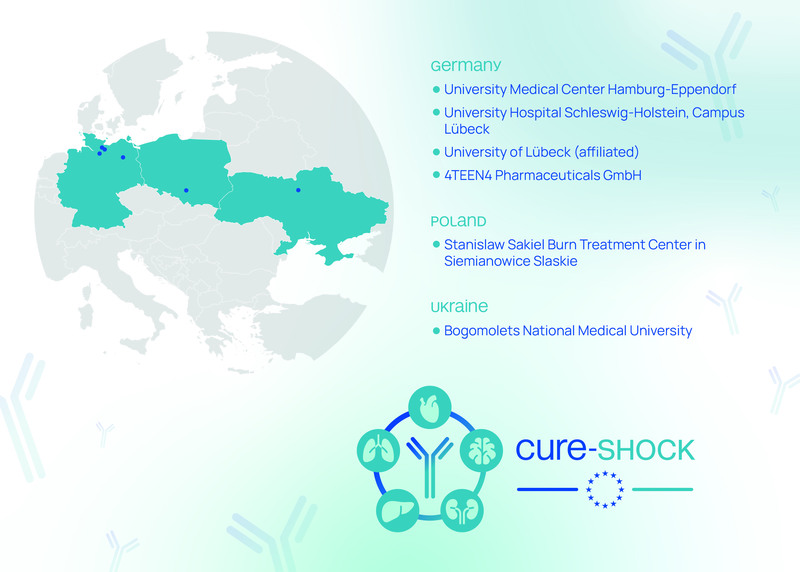
The project brings together leading clinical centres, academic research institutions, and biotechnology companies from three European countries:
Germany
University Medical Center Hamburg-Eppendorf (UKE) – Project Coordinator
University Hospital Schleswig-Holstein (UKSH)
Institute of Cardiogenetics Lübeck
University of Lübeck
4TEEN4 Pharmaceuticals GmbH – Developer of the innovative investigational medicinal product
GKM Gesellschaft für Therapieforschung mbH – Full-service Clinical Research Organization (CRO)
EURICE – European Research and Project Office GmbH
Poland
Stanislaw Sakiel Burn Treatment Center – Specialized Burn Treatment Centre
Ukraine
Bogomolets National Medical University (NMU) – the sole Ukrainian medical higher education institution participating in the consortium.
Aim and Relevance
Circulatory shock resulting from severe infections (sepsis), critical thermal injuries (burns), or major trauma remains one of the most challenging conditions in emergency and critical care medicine. Despite significant advances in intensive care, mortality rates among patients with these conditions remain exceptionally high, ranging from 30% to 50%. Current treatment strategies are largely supportive and symptomatic, addressing the clinical manifestations rather than the underlying biological mechanisms responsible for myocardial depression and cardiovascular failure.
The primary objective of the CURE-SHOCK project is to evaluate the safety, pharmacokinetics, pharmacodynamics, and therapeutic efficacy of the innovative monoclonal antibody Invobenitug (previously known during preclinical development as Procizumab), developed by 4TEEN4 Pharmaceuticals GmbH, through a multicentre, randomized Phase 1b/2a clinical trial.
The investigational medicinal product is based on a novel mechanism of action. It selectively neutralizes the excessive activity of the circulating enzyme dipeptidyl peptidase 3 (cDPP3). This enzyme is released into the bloodstream following extensive cellular damage and degrades key regulatory peptides, including angiotensin II and enkephalins, thereby contributing to persistent cardiovascular collapse and severe myocardial dysfunction. By inhibiting cDPP3, Invobenitug has the potential to restore haemodynamic stability, protect vital organs from the progression of multiple organ failure, and reduce the need for aggressive vasopressor support in critically ill patients.
Key Objectives
Clinical Trial Implementation: Organization and successful execution of a multicentre, stratified Phase 1b/2a clinical trial involving patients with septic shock and burn shock.
Implementation of Point-of-Care Diagnostics: Validation and deployment of Point-of-Care (PoC) diagnostic testing for rapid bedside measurement of the cDPP3 biomarker, enabling precise patient selection based on predefined inclusion criteria (cDPP3 ≥ 40 ng/mL and lactate ≥ 2.0 mmol/L).
Establishment of a Biobank: Development of a centralized biobank of patient blood samples to support future translational and molecular research aimed at elucidating the mechanism of action (MoA) of the investigational medicinal product.
Data Standardization: Development of a secure, centralized digital clinical trial database in full compliance with Good Clinical Practice (GCP) standards and international regulatory requirements.
Strengthening European Bio-Resilience: Enhancing Europe’s technological sovereignty and health resilience through the development of innovative biotechnology-based therapeutic solutions for the management of critically ill patients in intensive care medicine.
Work Packages
Researchers and clinicians from Bogomolets National Medical University play an active and integrated role in the implementation of the project’s work packages, leveraging the University’s unique clinical infrastructure and the expertise of the Kyiv Burn Centre:
WP6 (Clinical Trial Concept): Contributing to the development, adaptation, and refinement of clinical trial protocols for burn patients, with a particular focus on individuals suffering from severe burn shock.
WP3 & WP7 (Clinical Trial Database & Data Management): Participating in the implementation of a harmonized clinical data management system, including standardized patient data collection, clinical safety monitoring, and pharmacovigilance activities, in close collaboration with the European Clinical Research Organization (CRO) GKM Gesellschaft für Therapieforschung mbH.
WP4 (Biobank) & WP11 (Molecular and Mechanism-of-Action Analyses): Implementing international protocols for phlebotomy, biospecimen processing, labeling, storage, and quality assurance, ensuring the integrity of biological samples for subsequent translational and molecular mechanism-of-action (MoA) analyses.
WP12 & WP13 (Dissemination and Stakeholder Engagement): Disseminating interim research findings, presenting project outcomes and clinical experience at leading international scientific congresses – including events organized by the European Burns Association (EBA) – and contributing to the project’s communication, dissemination, and stakeholder engagement activities.
Expected Results
Generation of clinically validated evidence on the safety and efficacy of Invobenitug, the first-in-class precision therapeutic, for the treatment of patients with life-threatening forms of circulatory shock.
Reduction in mortality rates and shortening of intensive care unit (ICU) length of stay among patients with septic shock and burn shock.
Establishment of a robust European clinical monitoring network for shock syndromes based on the implementation of innovative cDPP3 biomarker-guided precision medicine approaches.
Full integration of Ukrainian medical science and the clinical infrastructure of Bogomolets National Medical University into the European Union’s clinical research and innovation ecosystem, strengthening international collaboration in translational medicine, critical care research, and advanced clinical trials.
NMU Project Team
Professor Sergii Zemskov – Director of the Educational and Research Institute of Medicine at Bogomolets National Medical University; Principal Investigator (PI) of the CURE-SHOCK project on behalf of Bogomolets National Medical University.
Professor Olha Kovalenko – Leading burn care specialist (combustiologist), Professor of the Department of Surgery with the Course of Hepatobiliary Surgery at Bogomolets National Medical University; Lead Clinical Investigator of the project.
Associate Professor Anna Blagaia – Associate Professor of the Department of Hygiene and Ecology at Bogomolets National Medical University; Daily Project Coordinator and Project Manager on behalf of Bogomolets National Medical University.
Associate Professor Ivanna Sakhanda-Piddiacha – Director of the Centre for International Academic Mobility and Grant Projects and Head of the International Relations Office at Bogomolets National Medical University; responsible for the project’s communication, dissemination, and visibility activities, including coordination of information support and promotion of project activities through the University’s official communication channels and digital platforms.
Funded by the European Union under the Horizon Europe Programme (Grant Agreement No. 101290723).
Views and opinions expressed on this page are those of the authors only and do not necessarily reflect those of the European Union or the European Health and Digital Executive Agency (HaDEA). Neither the European Union nor the granting authority can be held responsible for them.